
the hinge

I didn't know what to write this week. That's not something I say easily….the writing usually finds me, whether in a conversation or a room, in something that's been sitting long enough that it needs to come out. This week it didn't.
The tank was lower than I wanted to admit, and the harder I pushed for a subject, the further away one felt.
So I stopped pushing and went and sat across from people instead. Then the essay walked in and sat down with us.
It always does, if you show up…
There is a moment, right at the beginning of a meal with someone you don’t yet fully know that I can’t stop thinking about…
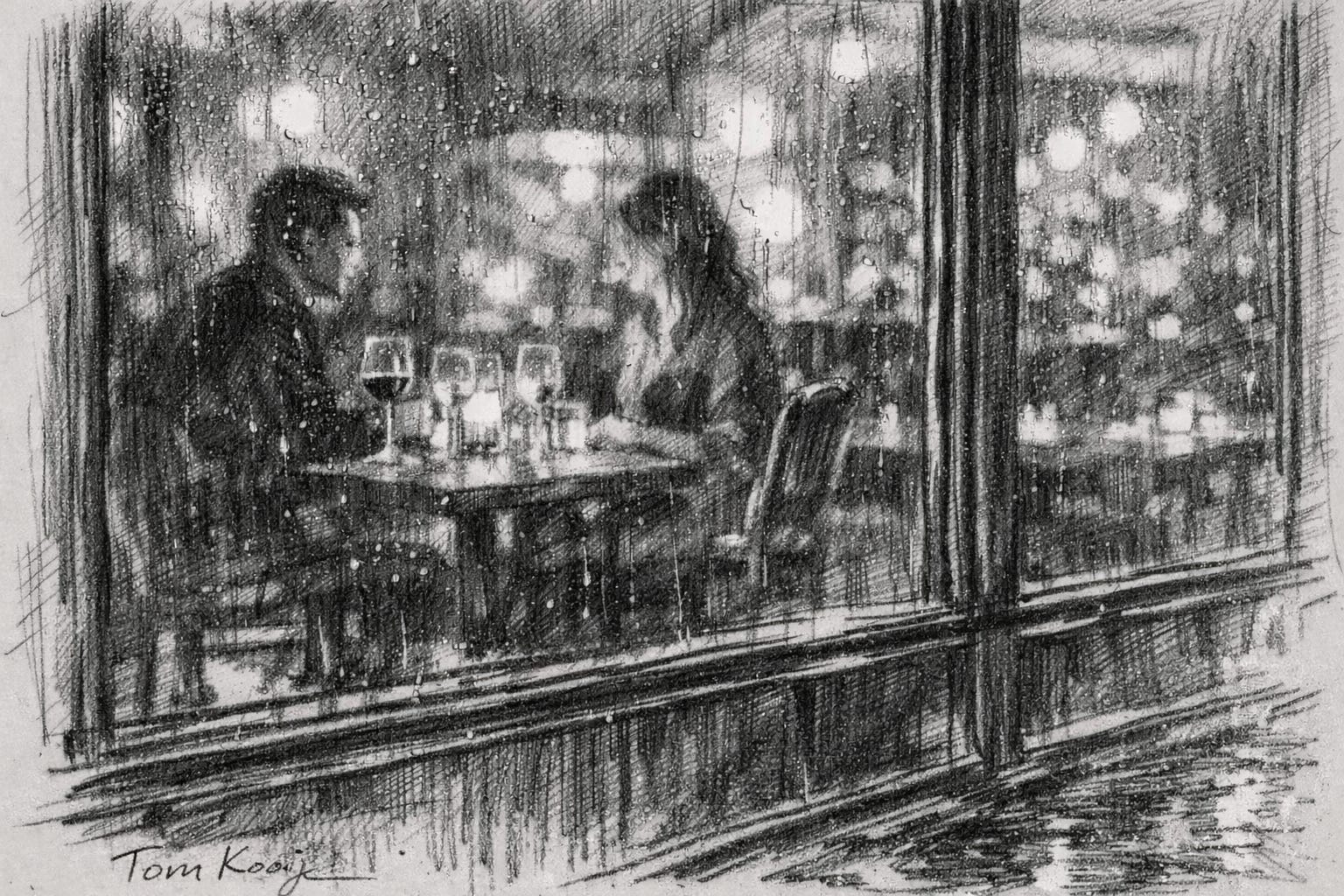
It starts before the menus are even open.
The waiter arrives. “Still or sparkling water?”, they say. And in that three-second pause, in that small, yet unremarkable question which opens every restaurant performance, you can already feel it…
"Still please", says the person who answers without even looking up, who has been drinking still water since 1984 and will not be considering alternatives. And right there, they have told you something…not about their water preferences, but about how they move through the world. That their decision was made long before they arrived and the waiter is simply the mechanism by which their desired outcome gets achieved.
Whereas the person who looks at you first, who says "what do you think?" or "I don't mind, you choose", has told you something different…a softness in the surrender, a desire to find themselves in relation to you before they understand themselves in relation to the evening and where it is going. Deep down they want sparkling, but they want the connection more…
Then the waiter leans in slightly, lowers their voice the way good waiters do when they’re about to offer something that isn’t written anywhere, and asks: “can I start anyone off with a cocktail or a glass of wine?”
This is where the theatre really begins. And it doesn’t matter whether there are two of you or eight, the table will tell you everything in the two seconds after that question lands.
One person reaches for the drinks menu immediately. They have been waiting for this all day. The negroni was always the plan. The sparkling water was just the opening act. Another glances at you, calculating, “are we drinking drinking, or are we going to behave?” Someone says “oh I shouldn’t” in a tone that means the exact opposite and will have the espresso martini. And then there is the person who leans forward and he asks the bartender, “what are you making tonight? what would you recommend? what is the kitchen is excited about??” It is with this kind of attention that makes the bartender a little unsure…as she stands slightly straighter at the table. He (the patron), it must be said, is probably also flirting. But here is the thing: genuine curiosity and flirtation are closer cousins than we pretend. Both require the willingness to be affected by the answer. The evening is still unwritten and he intends to keep it that way…
And then there is always someone who says “just water for me” with that health-kick-infused finality that closes a door, not just on the cocktail (and the bartender’s hopes of upselling), but on a certain quality of evening. For them the evening was over before it began…
The extended wine list arrives. And there’s a person who asks quietly “whether the sommelier has anything open under the Coravin or in the Enomatic?”, “whether there’s a Barolo or a white Burgundy worth trying by the glass that is hidden behind the bar?”…that person has just told you everything….that they know enough to ask and they are curious enough to want to know. Also, they are open enough to let the answer change the direction of the night.
And all of this before a single menu has been opened and in the space of a few minutes.
The evening hasn’t even started yet and it has already told you everything.
The hinge has already begun.
I call it that, the hinge. The space that hasn’t formed yet. The human moment before the social scaffolding goes up, before the roles settle, before the people around the table have decided what this evening is going to be. It is one of the most psychologically rich environments available to us and yet, most people move through it as fast as possible.
My advice? Don’t.
Sit inside that space. Enjoy it. Let it be unstructured for a little longer than is comfortable.
Because before anyone has ordered, before the evening has found its shape, before the person across from you has had time to become the version of themselves they brought for the occasion, they are still fully themselves. Unmanaged. Unoptimised. Not yet performing.
That is when you see it.
The drinks arrive. A negroni, a glass of something the sommelier was excited about, sparkling water for the one who always has sparkling water. The room settles slightly, the way rooms do when something has been placed on the table and the waiter has retreated.
And then the lag.
The space between the drinks landing and the order being taken. Five minutes, sometimes ten. The hinge is at its most alive. Nothing is required of anyone. The evening is genuinely formless and what happens in that lag, what fills it or doesn’t, is the most honest data point the evening will produce.
Stephen Porges spent decades mapping what he called neuroception, the nervous system’s capacity to detect safety or threat before the conscious mind has registered anything at all. Not perception. Neuroception. The body reading the room. The autonomic nervous system scanning the other person, their facial expression, the quality of their attention, the micro-movements of their posture, and deciding, long before any conscious thought arrives, whether it is safe to open or necessary to close.
This is what happens in the lag. The body arrives at the table before the mind does.
When genuine presence meets genuine presence across a table, the nervous system registers it as safety. And in safety, things open. The guarded self relaxes its grip. The managed version of the person softens at the edges. The thought that was too uncertain to say out loud becomes sayable. The question that felt too revealing to ask gets asked anyway…
But the person who reaches for their phone in that lag (and there always is one), who cannot tolerate five minutes of unstructured space, who needs to fill it with something from somewhere else, their nervous system has just told you something their mouth hasn’t said yet. They are not here in the moment. They are managing the distance between here and somewhere more comfortable. The phone is the still water of the soul…
Observations like the phone face-down matters, the eye contact matters. The unhurried quality of not yet knowing what you want matters, because it signals to the other person’s nervous system that you are actually present, in this moment, available for whatever the evening might become…
The warmth of the room. The clink of glass at other tables. The low conversation of people who have already found their rhythm. The body knows all of this. It has always known.
Now the menus.
There are people who have already decided before they arrived. They researched the menu online the night before. They know what they’re having, the duck confit, the wagyu beef wellington, the truffle pasta that got three mentions in the reviews and they know the wine to go with it. Not because they’re showing off, though sometimes they are, but because uncertainty is uncomfortable and certainty is what they’ve built their life around. The menu is a formality. The waiter is a means. They are here for the outcome, not the process. When the waiter returns they are ready and they order with a quiet efficiency that closes off something in the room before anyone else has finished reading the entrées.
There is nothing wrong with this, but notice what it costs.
The decision made in advance is the decision that doesn’t respond to the room. The wine chosen the night before doesn’t know that the evening called for something different, maybe Champagne to celebrate news they were unaware of or something lighter, something that matched the specific weather of the conversation rather than the theoretical meal. The pre-ordered dish in the head doesn’t leave room for the waiter to lean in and say “the kitchen just got in some extraordinary shark-bay scallops, we’re only doing six portions tonight” and for that information to change everything about what you order and how the next two hours feel.
Then there are the others.
The ones who read the menu like it might tell them something prophetic. Who ask the waiter what they would recommend and actually listen to the answer, not nodding while already decided, but genuinely receiving it, letting it land, allowing it to redirect. Who look around the table and say “should we get some bread and the charcuterie to share first?”, not as a social performance but as a genuine question. An opening. A small act of surrender to the possibility that what’s about to happen might be better than anything they could have planned.
Do they want the Albany Rock oysters? The beef tartare? The burrata with the heirloom tomatoes that the waiter mentioned almost as an afterthought? They might. They hadn’t decided yet. They’re still in conversation with the evening.
Otto Scharmer, the MIT theorist who spent decades studying how genuine transformation happens in groups and organisations, calls this quality of presence presencing, the capacity to sense and bring forth the emerging future rather than simply replaying the patterns of the past. The highest form of listening, he argues, is not downloading (confirming what you already know), and not debating (defending what you already believe), but something rarer and more difficult. A listening so open that it creates the conditions for something genuinely new to emerge. Something anyone brought to the table. Something that could not have existed without the specific quality of contact between them…
The people still reading the menu is practising this without knowing it. They are available to what the evening might become. The person who already ordered in their head is not.
The starters arrive. Something shared, the charcuterie board, a plate of olives, the burrata, even some oysters after all. The table finds its first rhythm. And something shifts, the way it always does when food appears and the hands have something to do and the conversation stops being managed and starts being inhabited. A piece of prosciutto. A smear of hand-whipped, luxurious, yet high-fat butter on bread. The specific pleasure of food that nobody had to cook and that will disappear without consequence.
This is the moment the real talking begins.
Not the warm-up. Not the managed version. but real talking that is tentative at first, then less so. Someone says something they hadn’t planned to say (maybe it is the Riesling talking). The other receives it. The hinge opens a little further. Nobody notices, because that’s how it works. The best conversations aren’t planned.
Which makes it worth asking: how often does this actually happen anymore? How often do two or more people arrive at a table without having already consumed a version of each other? Because here is what social media has done to this.
It has taken the hinge and removed it.
The digital version of meeting someone doesn’t have a hinge. You have already seen their feed before you have seen their face. You know their opinions before you know their laugh. You know what they ordered last time they ate at a restaurant because they photographed it and posted it before they ate it. You have consumed a curated version of their life, the version they chose to make public, edited for impact, optimised for the response it produced and you bring all of that into the room before the menus are even open.
The table that should be unformed arrives pre-formed. The person who should still be unknown is already categorised. The evening that should be on hinge has already been decided by the algorithm before either of you sat down.
This is what I mean when I say we have made life into 1s and 0s.
Not that technology is evil, it isn’t. But the algorithm is, by design, a flattening instrument. It takes the full-spectrum, endlessly complex, beautiful human being and reduces them to a data point. Engagement or non-engagement. Like or no like. Follow or unfollow. The infinite shades of a person compressed into whether the content performed. You cannot compress a human being into content without losing something essential. You lose the hinge. You lose the thing that only becomes visible in that formless space.
The hinge is the opposite of the algorithm. It is the moment where the person in front of you is still fully themselves, uncompressed, unoptimised, not yet performing for any metric and you are in genuine contact with that. Not their feed or their highlight reel. Not the version they prepared in advance. The actual person, still in conversation with the evening, still deciding whether to order the oysters before the mains arrive.
That contact is increasingly rare and we are impoverished by its rarity in ways we haven’t begun to fully account for.
The main course arrives.
Whoever ordered the duck gets the duck. The scallops, it turns out, were worth the recommendation. Someone made a decision at the last minute, changed their mind from the wagyu beef wellington to the whole roasted Goldband snapper, something they almost never do, and is already wondering if that small act of spontaneity is going to pay off. It will. It always does when it comes from the right place.
The evening has found its shape by now. The conversation has settled into something lighter than either person expected, or deeper, or both simultaneously. The waiter refills a glass without being asked. The room has its own sound. The table also. Nobody at the table is thinking about their phone.
This is what genuine presence actually produces. Not a technique. Not a practice. A quality of contact between people that the evening builds toward….if nobody closes it down too early.
Now, imagine what it would look like if organisations actually operated from this place.
Not the version they describe in the values document, we are people-centred, we lead with empathy, but the actual thing. The leader who arrives at the meeting without having already decided how it is going to go. Who reads the room like it might tell them something. Who asks the question they actually want to know the answer to and then, this is the part that almost never happens…..waits. Not formulating the response. Not managing the direction. Waiting. Present. Genuinely open to what emerges in the space forming.
The meeting that operates from this place doesn’t produce the outcome that was prepared in advance. It produces something better. A direction that emerges from genuine sensing of the situation rather than the replay of last year’s strategy. A decision that carries the full weight of everyone’s actual intelligence rather than the agreed-upon version of it.
This is what Scharmer means by sensing from the future as it emerges. Not prediction. Not planning. The capacity to be so genuinely present to what is actually happening, in the room, between the people, underneath the presenting conversation, that what needs to happen next becomes visible. Not because you were smart enough to figure it out in advance. Because you were present enough to let it arrive.
Imagine a town that operated this way. A nation. The policy that comes from genuine encounter with the people it affects, not the data set that has already flattened them into a demographic, not the focus group that has already reduced them to a set of concerns, but actual people, at an actual table, in the actual hinge of an unformed conversation, saying what they actually think rather than what the situation seems to require.
I know how this sounds. But I am not talking about utopia. I am talking about a meal. I am talking about what becomes available when two human beings decide, for the duration of an evening, to let the space form rather than pre-forming it…
Multiplied across enough tables, it is what culture is actually made of.
The dessert menu arrives.
By now the evening has done something to all of you. The person across the table is not quite the person who sat down. Neither are you. Something has shifted in the accumulated weight of two or three hours of genuine contact, gradually and undramatically, the way most real things change but something has shifted...maybe you know what it is…
The waiter sets down the menu. A burnt-Basque cheesecake with raspberry coulis. A dark chocolate fondant, still warm, with salted caramel and crème fraîche. A passionfruit soufflé that requires twelve minutes and a certain faith that it will arrive as promised. The cheese board, for those who treat dessert as a philosophical rather than a culinary question…
Watch what happens here.
The person who orders without hesitation, who has known since they walked in that they would have the crème brûlée, who doesn’t need to look at the rest of the menu, is the same person who knew the wine before they arrived. The same person who had still water without looking up. Consistent all the way through. The evening was always going to be executed, not lived, not inhabited.
The person who agonises, who reads every description twice, who asks whether the soufflé is really worth the wait, who considers sharing something and then decides against it, is the same person who leaned forward at the start of the evening and asked the bartender what she was making tonight. Still in conversation with the evening. Still open to being surprised by it…
And then there is the person who spent the whole meal performing restraint. “I’m being good tonight. Just a coffee for me.” They’ve been saying some version of this since the bread arrived. They waved away the starters. They ordered the fish because it was lighter. They declined a second glass.
And now, after two and a half hours of conversation that went somewhere they didn’t expect, something the evening unlocked within them, something the other person said that landed differently than it should have, some accumulated weight of genuine contact….they then look at the Basque cheesecake with the raspberry coulis and something gives…
“Actually. Yes. I’ll have that.”
The armour came off somewhere between the starters and the main and they didn’t notice until right now.
That person has just told you the most interesting thing of all. Not about cheesecake, but about what happens when the hinge stays open long enough.
All of it is data. All of it is the person, visible, moving through the full arc of an evening they didn’t entirely control.
The hinge is where the human being is still fully themselves.
If the evening was allowed to form. If nobody closed it down too early. If the phone stayed face-down and the conversation went somewhere neither person planned.
Then the person sitting across from you at dessert is more themselves than when they arrived. Not because anything dramatic happened. But because the space was held open long enough for something real to come through.
That is not a small thing.
The reason individuals, organisations and towns and nations don’t operate this way is not cynicism or malice or even selfishness, mostly.
It is unfamiliarity.
People who have never been truly received by another human being do not know how to receive. People who grew up in the managed, optimised, digitally mediated version of human contact do not have access to the alternative…..not because they don’t want it, but because they have never seen it modelled. They have never experienced the lag. They have never ordered the soufflé on impulse and understood what that impulse revealed. They have never sat inside that unstructured space long enough to find out what it produces.
They have never experienced the hinge.
And so they carry their pre-formed, pre-planned decisions into every room. They already know the wine. They already know what they think about you. The menu is a formality. The evening is something to execute rather than truly live in…
The cost is quiet. It accumulates slowly in the texture of a life. The conversation that almost happened and didn’t. The person who almost said the true thing and pulled it back into something safer. The meal that was pleasant and forgettable and left both people slightly more alone than when they first arrived.
It is the hinge that never opened.
A culture that has lost the capacity for genuine presence does not suddenly recover it through better technology or more efficient systems or a new values framework. It recovers it the way it was always built, one table at a time, one evening at a time, one person deciding to arrive without having already decided…
I didn’t know what to write this week.
Then I went and sat across from people. Watched the table before it formed. Noticed who had already decided and who was still open. Watched someone spend three minutes with the dessert menu, genuinely (and joyfully) deliberating, genuinely present to their own desire, and then order the burnt-Basque cheesecake with the raspberry coulis like it was the most important decision they had made all week.
Maybe it was.
The essay was always there. Waiting in the hinge. In the specific quality of a space that hadn’t yet formed.
You cannot find this behind a screen. You cannot find it in the back-channel messages or the curated feed or the opinion you’ve already formed about someone you haven’t actually sat across from. You can only find it in the room, at the table, in the quality of attention you bring to the person across from you and the willingness to let what emerges actually emerge.
That is the whole argument. The rest is seasoning.
Go put your phone face down.
Order something you haven’t had before…
Let the evening be unstructured, formless, even just for a few minutes to start, then see what walks in and sits down with you…
— TK