
The Oldest Demon

There is a moment in almost every serious conversation where the real thing finally surfaces. Not at the beginning, never at the beginning. It comes after the presenting problem has been examined from every angle, after the careful language has done its work, after the person across from you has run out of reasonable explanations for why their life feels the way it does. The room gets quiet in a particular way. And then, underneath everything they came in carrying, the same thing.
It is always the same thing:
The fear of being seen and found wanting.
“I am not enough. And if anyone looks closely enough, they will know it.”
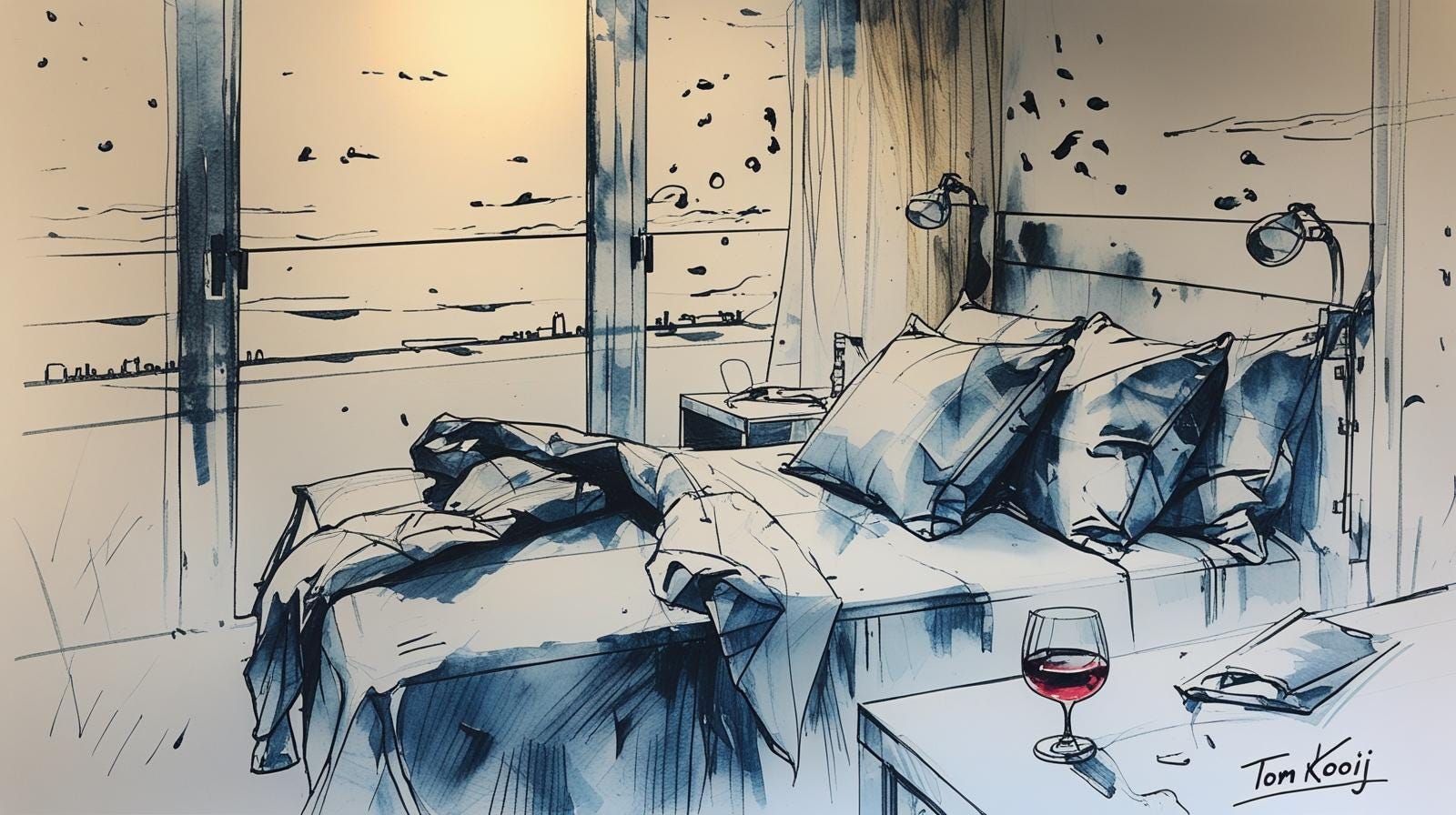
It doesn’t matter how much has been built. How many rooms have been walked into and held together by sheer force of will. How many complex problems solved, how many people led through the difficult years, how many things made real that simply would not exist without them. The fear doesn’t respond to evidence, but it predates evidence. It is older than any achievement stacked against it, and it will outlast all of them if it goes unnamed.
This is not a leadership problem, a confidence deficit, or something that dissolves with the right coach (the kind who charges four figures a day to tell you what you already know) or enough offsite days where everyone agrees to be vulnerable on a schedule and calls it culture…..but it is the oldest human problem there is and it is running, right now, underneath every organisation, every culture, every civilisation that has ever softened from the inside out.
This is not because its people lacked ability, but because the people at the front of the room were too frightened to be seen clearly, and built entire systems to make sure they wouldn’t be.
We have always had a word for the person who rose too high and believed their own story. It is, hubris. The Greeks wrote tragedies about it, the Romans built cautionary monuments to it, and every borderline-irrelevant MBA programme with a failed leadership case study reaches for it eventually….the overreach, the arrogance, the god-complex that brought the empire low. But twenty years of sitting in those rooms tells a different story.
The people who do the most damage are almost never the ones who believed too much. They are the ones who, in private, believed too little and built an empire of performance around the gap.
A wound dressed up as confidence. So terrified of being found insufficient that they surrounded themselves with people who would never tell them the truth. They made decisions designed to protect the image rather than serve the mission…and gradually, without ever intending to, without ever quite noticing, constructed an institution in the shape of their own unexamined fear.
The psychologists have been mapping this territory for decades. John Bowlby, the British psychiatrist who spent his career studying how the earliest relationships shape the nervous system for life, called it anxious attachment. This is the system calibrated in childhood to expect that love is conditional, that presence will be withdrawn, that the self as it actually is will never quite be sufficient to keep the people it needs close. Donald Winnicott, the British paediatrician and psychoanalyst who worked with thousands of children and their mothers, called it the false self, the adaptive personality constructed to meet the demands of an environment that couldn’t tolerate the real one, the mask that starts as protection and eventually becomes the only face the world sees. Carl Rogers, the American psychologist who pioneered person-centred therapy and spent a career sitting with people who had lost their way back to themselves, documented what happens when the conditions of worth placed on a child are impossible to meet, the self splits, the performance begins, and the gap between who you are and who you must appear to be becomes the defining architecture of an entire life.
What all of them are describing, in their clinical, bloodless language, is a person who learned early that being truly seen was dangerous, that the authentic self, the one with the fears and the doubts and the needs and the contradictions, was not safe to bring into the room. And so they built another one: competent, controlled, impressive in exactly the ways that matter, and utterly, invisibly exhausting to maintain.
Then they became a leader and the room got bigger, the stakes got higher. The performance had to scale. And somewhere in that scaling, the mask and the mission became indistinguishable from each other. Because underneath the performance, underneath every version of it, in every person running it, there is something older than ambition and more persistent than fear. Call it the demon. It has been there since the beginning and it will be there at the end. And it is running, right now, in more rooms than anyone would like to admit.
The demon is not self-doubt. Self-doubt is useful, it keeps the edges honest, and the best builders I have ever met are riddled with it. They just don’t let it make the decisions.
The demon is something older and more total than doubt. It is a cellular belief, felt in the body before it is articulated by the mind. Not about the version of you that walks into rooms and holds them. But about the one that lies awake at three in the morning running the same conversation on repeat. The one that sometimes feels like a fraud wearing a suit that almost fits. That person, fully visible, would not be tolerated.
The demon believes that love, respect, belonging, the whole architecture of the life you have built, is conditional on the performance continuing. That the moment if it slips, even slightly, everything built on top of it comes down. It has believed this for a very long time. And it is very good at making sure you never stop to question whether it’s actually true.
And so the performance continues.
You get better at the room. More fluent in what people need you to be, and faster at becoming it before they’ve finished asking. You learn to use busyness as insulation, move fast enough and nobody can get close enough to see. You develop a particular kind of charm that invites people in just far enough and no further, warm enough to build trust, contained enough to stay safe. You build a life of extraordinary competence around a core of quiet terror and call it professionalism.
For years, sometimes decades, it works. Until the body starts sending invoices.
I think of a man I know, someone I’ve sat across from in a room that told you everything about the story he’d built around himself before he said a word. A corporate litigator. One of the best in the country at what he does, the kind of person who walks into a room and changes its atmospheric pressure just by being in it. His office is immaculate in the way that tells you it was planned, not inherited. Banksy-inspired art on the walls. Herman Miller chairs. The acquisitions that made the firm grand are framed opposite his desk, each one a data point in the story he has built about himself, each one holding the story together a little more. The car collection, several Ferraris, other brands sits in a garage that most people will never see but that he knows is there. The income and record is extraordinary.
He is on his third divorce. He wants to get back with his first wife. He has a history with addiction that he has managed, mostly, in the gaps between performances. And underneath all of it….underneath the office and the cars and the record and the particular authority that enters every room with him, he is terrified. Not of losing a case. But of being seen. Of someone getting close enough to notice the distance between the man his clients trust with the most painful moments of their lives and the man who goes home to an empty house and doesn’t know what to do with the quiet.
Nobody in his professional world knows any of this. They see the performance. The performance is superhuman. That is the point.
Peter Levine, the American therapist and neuroscientist who spent forty years studying how trauma lives in the body long after the conscious mind has moved on, understood that the nervous system keeps score in ways that no amount of performance can edit or manage. The hyper-vigilance that never quite turns off. The insomnia that sits like a low hum beneath everything. The anxiety without a clear object that arrives on Sunday evenings and doesn’t leave until Wednesday. The way certain kinds of scrutiny, a particular tone of voice, a question that lands slightly wrong, a silence in a room that lasts a beat too long, produce a physical response that has nothing to do with the actual danger present and everything to do with a threat that was real once, a long time ago, in a much smaller room.
These are not symptoms of stress. They are symptoms of a nervous system that has been running on high alert for so long that it has forgotten what settled feels like. A system calibrated, early in life, to treat visibility as threat — and still faithfully executing that calibration decades later, in a world that has changed entirely around it.
The executive in the corner office with the city at her feet and the success everyone admires, who hasn’t told a single person in her life that she feels like a fraud. The founder who raised the round and hit the milestone and still wakes at four in the morning with the familiar cold weight settling on his chest, the one he has never described to anyone. The leader who has held her team together through two years of genuine crisis and has no one (not one person) she can be honest with about how thin she actually is. The board chair who runs every room he enters and has never, not once, let a room run him.
All of them running the same ancient programme. All of them paying the same invoice, in the same currency; presence, clarity, the capacity to be genuinely available to the people and moments in front of them. All of them carrying something that has never been named out loud because naming it felt more dangerous than carrying it.
I have sat in enough rooms to see what this looks like from the outside, and it has a texture you start to recognise. There is a quality of attention in a person performing sufficiency that is ever so slightly off. Not obviously…they are far too good for that. But there is a fraction of their awareness that is always monitoring the room, always checking the read, always running a background process that has nothing to do with the conversation in front of them and everything to do with managing the gap between what they are and what they need to appear to be. You can feel it if you know what you’re looking for. A slight tension behind the eyes. The way certain questions land just a beat too long before the answer comes. The laugh that is a fraction too easy. The certainty that is a degree too absolute, the kind that has been decided in advance rather than arrived at in the room.
And underneath all of it, when the performance finally has nowhere to go there is the exhaustion. It isn’t tiredness, but bone-deep exhaustion of someone who has been holding a posture for so long they have forgotten what it feels like to put it down.
These are not morally compromised people. They are not weak. They are people doing what the human nervous system does when it learned, in the most formative years of a life, that the cost of being truly seen was too high. They are running a survival strategy that once made complete sense and has long since outlived its usefulness. And they are, every single one of them, paying a cost that extends far beyond themselves…
This pattern does not stay private either. It never has.
The leader who cannot be seen cannot see clearly. Not because they lack intelligence, most of them have more than enough of that. But because a significant part of what they have is already spoken for, already burning in the background, committed to keeping the gap invisible. Monitoring the impression and maintaining the story. Making sure the room never gets close enough to notice the distance between the person standing at the front of it and the person who goes home at the end of the day and takes the mask off in an empty hallway.
And that energy has to come from somewhere, it always does. It bleeds out of the quality of their attention, that fraction that is always elsewhere, always half in the room and half running the calculation of how they are being received. It comes from the capacity to sit still long enough to hear something they don't want to hear, which requires a kind of quiet they can never quite find. From the courage to make the decision that is right rather than the one that keeps the story intact. Every hour spent managing the gap is an hour stolen from them. Every room they couldn't be honest in is a room where something that mattered didn't get said.
And that blindness compounds. The person performing sufficiency cannot accurately assess insufficiency in the system around them, as they are too busy managing their own to notice it spreading through everyone else's. The one who has never faced their own fear of being found wanting cannot recognise when an institution is dying of the same disease, because the disease looks familiar, looks normal, it looks like Tuesday.
And so the private demon becomes public policy. The personal avoidance becomes organisational culture. The unexamined fear of the person at the front of the room becomes the unspoken rule of every room beneath them, scale that across enough leaders, enough institutions, enough generations of people who were never quite brave enough to be seen and who built systems in their own image, and you begin to understand how civilisations soften.
Not through some external attack like an invasion or famine or the slow failure of infrastructure. Through something quieter and more preventable, leaders so consumed with managing how they appeared that they gradually lost the capacity to do the thing appearances were supposed to be in service of. The mask outlasted the mission. And nobody noticed, because by the time it happened, the people who might have said something had learned not to.
The Romans felt this. Every declining empire has felt it. The institution that once built what nobody else could build, that once moved with the particular confidence of people who knew exactly what they were for, slowly becoming an elaborate machinery for protecting the people inside it from the consequences of honest self-examination. We call it bureaucracy. We call it politics. We call it the failure of nerve. It is almost always, underneath every one of those descriptions, the oldest demon — running unchecked, scaling with the institution, compounding quietly across time until the thing in front of you no longer resembles what it set out to be, and the people inside it have forgotten it ever was.
But some people, in every era, in every institution, chose differently. Not because they were built differently. Because at some point they stopped running.
The ones who faced it were different. They weren’t perfect or fearless. They were not without the demon (the ones who claim to be without it are usually the most thoroughly in its grip). But they were willing. Willing to sit with someone they trusted and say the thing out loud - “I don’t know if I am enough for this.” They were willing to let the mask come off in at least one room and discover, usually with some surprise, that the person underneath was not the diminished and insufficient thing they had spent a lifetime fearing, but something more real, and therefore more capable, than anything the performance could have produced.
Because here is what the demon doesn’t tell you, being seen is not the end. It is the beginning…
The person who has been seen and survived it, who has named the fear out loud and watched the world fail to end, moves differently through every room after that. Not because they have no fear. But because the fear no longer has to be managed in secret. It no longer runs its invisible tax on every interaction, every decision, every moment of scrutiny. The bandwidth that was spent on maintenance comes back. The attention clears. The quality of their presence shifts in ways that other people feel without being able to name, a settledness, an availability, a particular kind of steadiness that is entirely different from performed certainty, because it has nothing to prove.
Winnicott called it the true self. Rogers called it the fully functioning person. The theologians called it integrity, the state of being undivided, of having the inside finally match the outside, of no longer spending any energy maintaining the gap between them.
I call it the beginning of the real work…
The question underneath all of this is simple and almost impossible to sit with.
Are you fully alive to what you are doing, or are you performing it? Because you cannot be both. You can be effective while performing. Impressive. Genuinely useful, even. People build real things behind masks. But aliveness? The kind that changes the temperature of a room just by walking into it, the kind that makes people decades later say “that person was the real thing”….that requires the parts of you the performance is specifically designed to hide.
The demon stands between you and that. It always has and it always will.
Name it. In one room. To one person. Out loud.
The demon doesn’t die. It just loses its grip on the controls. And the person who has named it, who has sat fully visible in at least one room and discovered they were still standing, moves differently after that. Builds differently. Leads differently. Leaves something behind that performing people, for all their competence, simply cannot.
The work begins not in the room where you are impressive.
But in the room where you are true.
—TK