
The Podium

Georgia is nine years old and she doesn’t know yet that the world will spend the next several decades trying to teach her to be afraid.
I've watched that happen to people. Watched the openness get educated out of them slowly, by parents and families conditioned by the generations before them, in staffrooms and boardrooms and performance reviews, until what's left is someone who's very good at managing the appearance of confidence while the actual thing quietly vacates the premises. It takes years. It's thorough. And it starts earlier than most parents want to believe.
She isn’t there yet.
The inter-school swimming carnival is not a refined-Olympic event. It is loud and chaotic and the chlorine at the aquatic centre is so thick it seeps through your clothes and into your skin and you will smell it for days regardless of how many showers you take. Parents sit in the humid heat on aluminium benches watching children in goggles represent their school against children in different coloured swim caps representing someone else’s school, for ribbons that cost less than a cup of coffee. Nobody is optimising anything. And yet the carpark is full, the benches are packed, and something in the room, in the noise and the heat and the smell, feels like something that actually matters…
That is worth sitting with for a moment. We live in an era that has systematically dismantled most communal rituals, the town hall, the local league, and replaced it with personalised digital experiences that connects us to everyone and binds us to no one. And yet here we all are, voluntarily, sweating through our shirts in a regional swimming pool because primary school aged kids are about to race. There is something anthropologically stubborn about it. Something that resists the algorithm. The swimming carnival doesn’t scale, can’t be streamed, won’t generate content. It just happens, in a specific place, with specific people, and then it’s gone.
Georgia stood behind the dive blocks and the nerves were written plainly across her face the way only children can, no learned concealment, no rehearsed composure, just a kid at the edge of something she wanted and wasn’t sure she could have. I know that feeling. I’ve walked into enough rooms carrying it to recognise it on someone else’s face from thirty metres away. On her it looked like courage. On most adults it looks like a liability.
Then the starter went and she was gone.
Not nervous anymore, not hoping, just swimming. Fully inside the thing, the way kids can be before the world teaches them to be somewhere else while their body goes through the motions. We spend a lot of time talking about grit, the grind, the perseverance, the willingness to stay in something hard, and Georgia had that. She had taken her nerves and aimed them, converted the anxiety into fuel, which is not a small thing at nine years old or any age.
But there is another kind of strength that doesn’t get the same airtime. Harder to measure, harder to teach, and if you believe the people who study these things seriously, more important than any of it. The capacity to be genuinely other-person-centered. To feel something fully and then look outward rather than inward. To win and think immediately of the people who didn’t.
That’s not grit, it is character. And you can’t drill it into a kid on a whiteboard, in a classroom.
What I watched in that pool was both, the will that got her to the wall first, and then the thing that mattered more waiting for her on the other side of it.
She touched the wall.
Looked up.
And you could see the exact moment the information arrived as she was handed the ticket to confirm her placing... It moved across her face the way weather moves across open country, disbelief first, a fraction of a second where she didn’t trust what her body was telling her, and then certainty, and then something just broke open. Pure uncontrolled joy, the kind that hasn’t yet learned to check whether anyone is watching before it shows itself. The kind adults spend years in therapy trying to locate again and usually can’t (not fully anyway), because the scar tissue is too thick by then.
I was already gone. Standing in a crowd of parents smelling of chlorine with tears filling my eyes and I wasn’t interested in doing anything about it.
But it wasn’t the winning that did it. I want to say that because it matters.
It was really the podium.
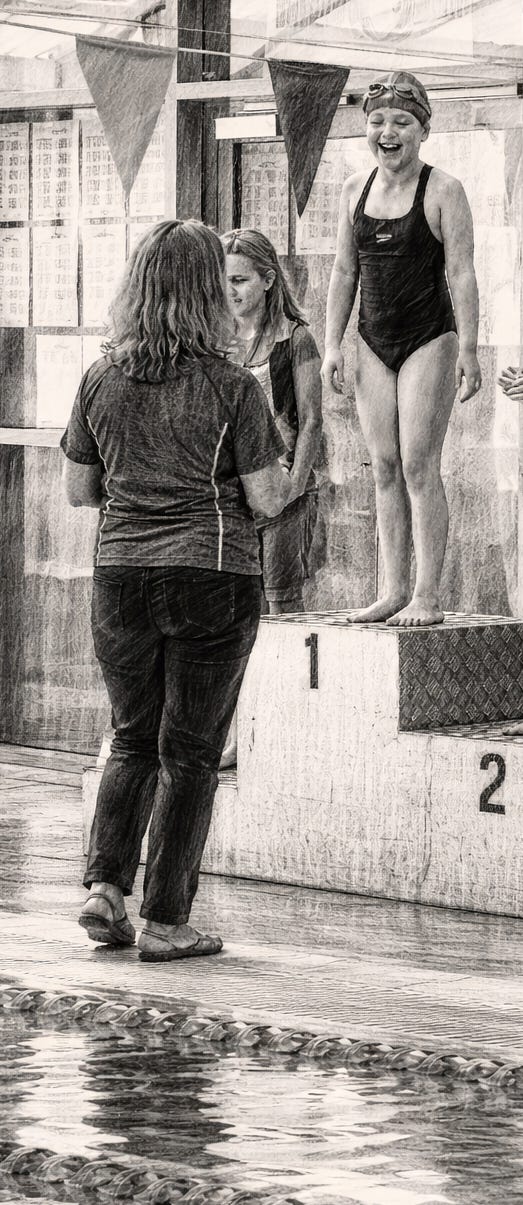
While Georgia was standing up there with the other girls, she wasn’t performing victory, she wasn’t doing the thing we see adults do, that particular small triumphalism, the managed graciousness that is really just dressed up pride. She was genuinely happy to be up there with them. Sharing the moment rather than owning it. Nine years old and she already understood something that takes most leaders a career to learn (if they learn it at all) that real joy does not diminish when you let other people into it. That the podium is better with company…
The thing about genuine other-person-centeredness is that you can’t manufacture it. You can’t put it on a rubric or run a workshop on it or incentivise it with a ribbon. Schools are only beginning to reckon with the fact that the qualities that make someone truly good, not accomplished, not high-performing, but actually good, can’t be measured. So mostly they don’t measure it. Mostly they just hope.
And here’s a nine year old doing it instinctively, in a regional pool that smells like it’s trying to dissolve you, because nobody had taught her yet that it was optional.
I have sat in rooms with people who haven’t worked that out. They have built entire careers on a competitive architecture that left them hollow at the top because they burned every relationship on the way up and there was nobody left to share the view with. Men and women who won and kept winning and couldn’t understand why it felt like nothing. Georgia stood on that podium and turned immediately to the girls who came second and third like it was the most natural thing in the world.
Because for her it was.
I stood there and let that settle. Somewhere underneath the pride was something less comfortable, the quiet recognition that I had to drive forty minutes and sit in an over-chlorinated regional pool to feel something that used to come more naturally. That it took my daughter winning a breaststroke race to get me fully out of my own head for twenty minutes.
That’s not her problem. That’s mine.
I have given my best hours to rooms full of adults who paid to be there. My kids got what’s left, the version that’s already been used, still half-inside whatever didn’t resolve before I walked through the door. I don’t think I’m unusual in this. I think most parents doing serious work are making the same quiet trade and not looking at it too directly because the looking is uncomfortable and the work still needs doing.
What Georgia gave me on in that swimming pool and on the podium wasn’t a full day. It was twenty minutes of being completely there. Watching properly. Letting it matter. The question that has been sitting with me since isn’t how much time we have, it’s what we do with ourselves when something real is happening right in front of us? Whether we are actually in it or just physically attending it?
I drove home with her in the seat next to me and we talked about the race. She told me she had been nervous before the blocks and I said “I know, I could see it”, and she said “I used it, dad”. Just like that, matter of fact, a nine year old explaining nervous energy as a resource rather than a liability, the way executives pay thousands of dollars to learn...
She wasn't even looking at me when she said it. Watching the road go past, the paddocks opening up, cows out to pasture. Already somewhere else, already nine again, the race filed away and the rest of the day opening up in front of her…
I didn’t say anything.
There wasn’t anything to say.
—TK